
2
Items
-

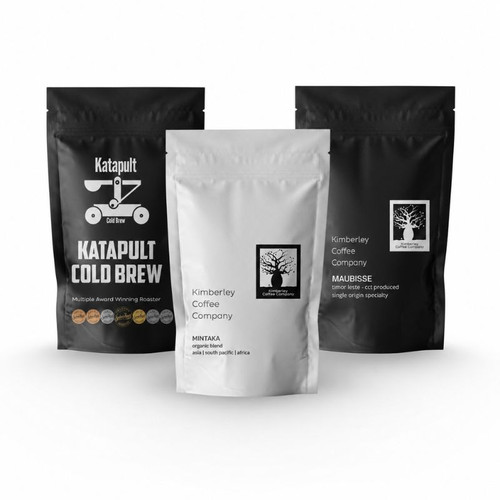
Maubisse - Timor Leste Organic Single Origin
$31.50 - $154.95 -
Showing 2 of 2 items
A beautiful single origin coffee from the mountain region of Maubisse, Timor-Leste - grown with care, shaped by community, and freshly roasted by Kimberley Coffee Company.
Shop Maubisse Single Origin Coffee
Read more: maubisse.com
Timor-Leste coffee is one of the most meaningful origins we roast. It is not only a beautiful coffee in the cup; it is a coffee connected to land, resilience, farming knowledge and community development.
In 2026, Mark and Sim visited Timor-Leste and travelled through coffee-growing regions supported by Cooperativa Cafe Timor, often known as CCT. We went because we love the coffee. We came home with a much deeper respect for the people, the mountains, the farming communities, and the extraordinary work being done around coffee, healthcare, training and long-term sustainability.
This page answers the most common questions people ask about Timor-Leste coffee and introduces our Maubisse Single Origin Coffee - a coffee we are proud to share with Kimberley Coffee Company customers.
Timor-Leste coffee is often loved for its balance. While every harvest, region and roast profile will vary, many Timor coffees are known for a full body, gentle sweetness, low to medium acidity and earthy depth. Depending on the lot and roast, you may find notes that sit in the chocolate, spice, toasted nut, soft fruit or caramel range.
Our Maubisse Single Origin is selected and roasted to show the natural character of this origin without overpowering it. It is a coffee with warmth and structure - satisfying enough for milk-based coffee, but still interesting enough to enjoy black when brewed well.
For customers who usually drink blends, Timor-Leste can be a beautiful entry point into single origin coffee. It has the character and traceability of a single origin without being too sharp, floral or unusual for everyday drinking.
Coffee in Timor-Leste is grown mainly through the mountainous interior of the country, where altitude, shade, rainfall and cooler highland conditions create an ideal environment for Arabica coffee. Key coffee-growing areas include regions such as Ermera, Ainaro, Aileu, Liquica, Manufahi and the mountain areas around Maubisse.
Maubisse is one of the regions that stayed with us. The journey through the hills is striking: winding roads, mist through the valleys, flowers, small villages, local produce for sale by the roadside, and children making their way to school through the mountains. It is a landscape that feels both rugged and deeply romantic.
For Kimberley Coffee Company, the place matters. Coffee is never just a bean on a shelf. It is connected to climate, soil, elevation, farming families, processing, transport and care at every step. Maubisse gives this coffee a strong sense of origin.
Maubisse coffee is special because it comes from a region where coffee is closely connected to daily life, rural income and community development. Coffee trees grow through the highlands, often in smallholder farming systems rather than large industrial plantations.
The Maubisse region has altitude, natural beauty and farming heritage. These conditions help create coffee with depth, body and character. But what makes this coffee especially meaningful is the wider story around it. Through CCT, farmers can access training, processing support, market access and more stable systems for selling coffee. This matters in regions where infrastructure, healthcare, education and income opportunities can be limited.
When we visited, we saw that the work around coffee was not only about export. It was also about strengthening communities. The coffee is excellent, but the story behind it is what makes it unforgettable.
Much of Timor-Leste coffee is grown in low-input systems, with coffee trees often cultivated under shade and with minimal chemical intervention compared with many commercial coffee-producing regions. Timor-Leste is widely associated with organic coffee production, and CCT has played an important role in bringing organic and fair trade coffee to export markets.
For customers, the word organic should always be understood in context. Some Timor-Leste coffees may be formally certified organic, while others may be naturally grown using traditional or low-input methods without carrying the same certification. For our Maubisse Single Origin, we will state the certification and sourcing details clearly on the product page and packaging information.
Sustainability is also about people. Farming training, crop diversification, pricing support and better processing systems all help create a more resilient coffee future. In Timor-Leste, coffee is not separate from community health, farmer income or long-term rural development.
Buying well-sourced Timor-Leste coffee can support farming communities by creating demand for a crop that is central to rural livelihoods. Coffee is one of Timor-Leste’s most important non-oil exports and provides income for many smallholder farming families.
CCT, the cooperative connected to this origin story, does more than help coffee reach export markets. It provides farmer training, processing support and market access, and has also contributed to healthcare services in coffee-growing regions. During our visit, we saw how important this community role can be, particularly in areas where access to healthcare, education and basic services is limited.
One of the most powerful examples we saw was the role of regional clinics, including facilities designed to help young families access safer birth support and ongoing healthcare. This is why this coffee feels different to us. It is a beautiful cup, but it is also connected to real people, real places and meaningful development.
Timor-Leste coffee is versatile, and the best brewing method depends on how you like to drink coffee. To enjoy the single origin character, we recommend trying it first as a black coffee using a pour-over, AeroPress, plunger or batch brew. These methods allow the body, sweetness and origin notes to show clearly.
For milk drinkers, Timor-Leste coffee can also work beautifully as espresso. Its body and chocolate-spice depth can hold up well with milk, especially when roasted with balance and freshness in mind.
For the best result, use freshly roasted coffee, grind just before brewing if possible, and match your grind size to your brew method. Use clean, good-quality water and avoid boiling-hot water directly on the coffee. Small details make a big difference, especially with single origin coffee.